Wild archipelago

The Mitsio Islands: “the wild north”

“5 days

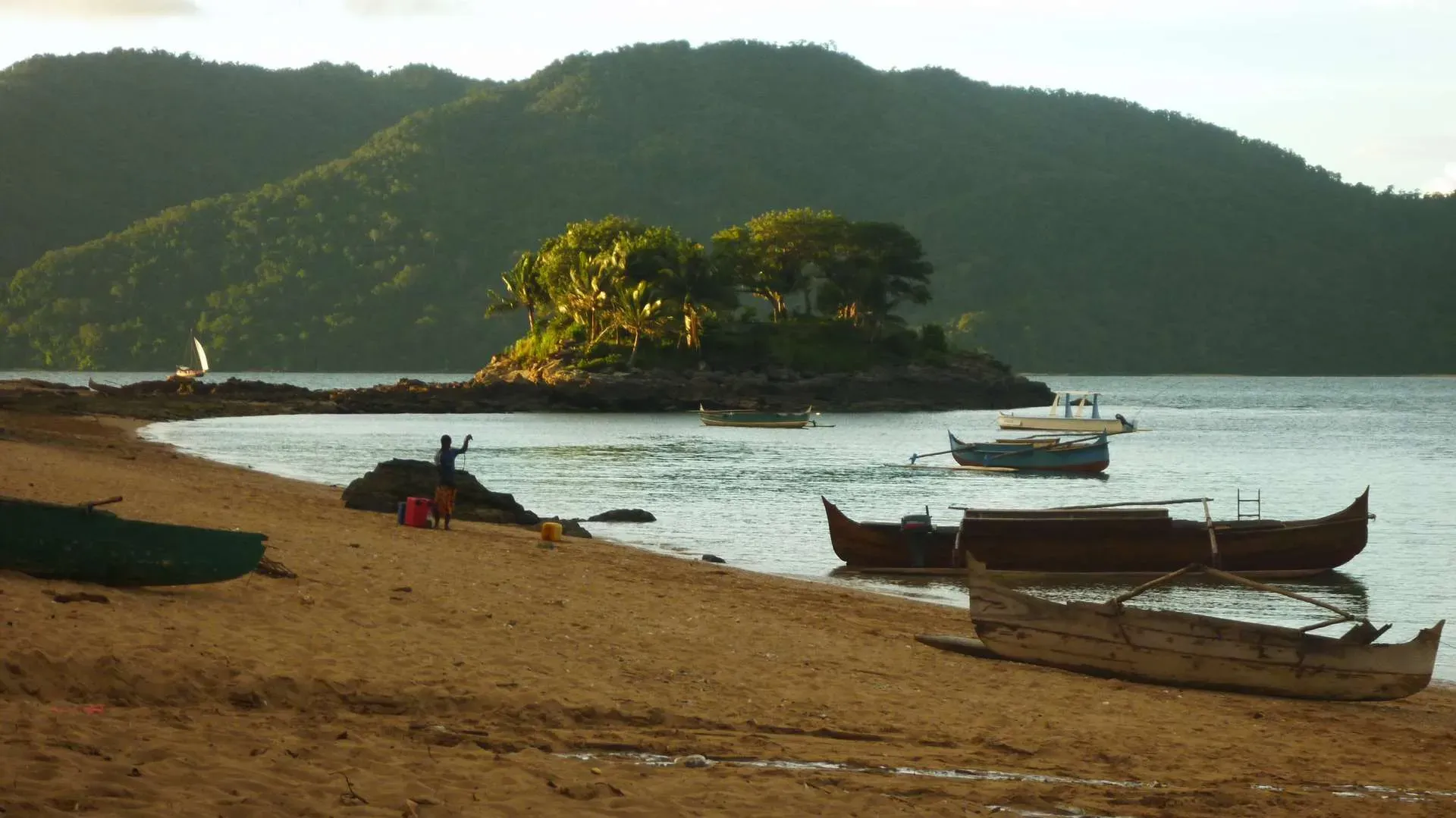
to discover the wild Mitsio archipelago, land of the Sakalava people, where only Nosy Mitsio is inhabited.

Rich wildlife and vegetation, a complete change of scenery and a magical atmosphere.

The basalt columns of Nosy Mitsio
The birdlife of the Four Brothers, the climb up Nosy Ankarea and its forests of pachypodiums
A méchoui barbecue on Maribe beach (on request and at the guests’ expense)
A game of pétanque on Maribe beach
The Ankoay (Madagascar fish eagle), one of the rarest birds in the world
  • Optional extension to Cape Saint-Sébastien (3 additional days).


Step by step

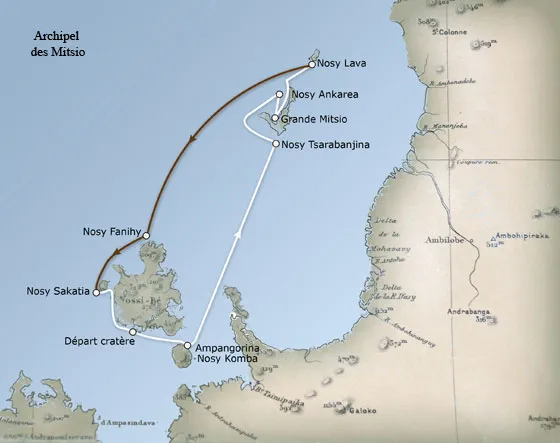
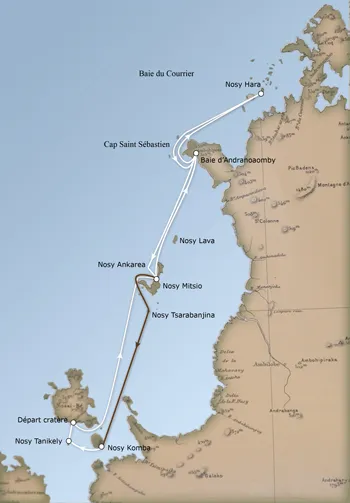
The itinerary

Day 1

Nosy be
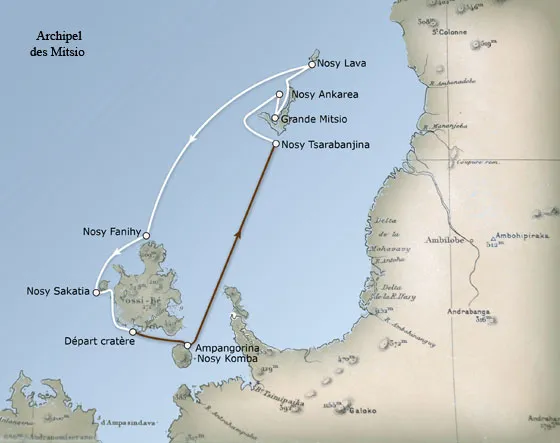
Nosy Komba (Ampangorina)
Nosy Tsarabanjina

“Early departure

from the Djebel Amour’s home port (Le Cratère), heading towards Nosy Komba and its main village, Ampangorina, 9 nautical miles away, or around 1 hour 30 minutes of sailing.

To port, the magnificent primary forest of the Lokobé Reserve, the only remaining area of original forest on the island of Nosy Be. This tropical rainforest drops dramatically into the sea, creating striking contrasts of emerald green and turquoise.

A peaceful, welcoming village, with the beachfront lined with embroidered tablecloths made by local craftswomen, Ampangorina is the perfect place to buy a few handicrafts or some vanilla. Children and adults alike will enjoy visiting the lemur park, where the lemurs are remarkably friendly and particularly fond of bananas.

At the end of the morning, departure for Nosy Tsarabanjina, 27 nautical miles away, or around 5 hours of sailing.

Leaving Nosy Komba, to starboard lies Nosy Vorona, the bird island, a tiny slice of paradise roughly the size of two football pitches. A concession was granted by the lighthouse authorities in return for maintaining a small lighthouse used by sailors, one of the few still operating in Madagascar.

Further on, Nosy Faly and its long white-sand beaches appear to starboard. After a few hours of sailing, you will reach beautiful Tsarabanjina, also known as the island of white sand. A sacred land of the Sakalava people, it extends over around twenty hectares, with lush vegetation and pristine beaches.

The island is home to abundant birdlife, including moorhens, frigatebirds, cormorants and, for the lucky ones, the Ankoay, or Madagascar fish eagle.”

Day 2

Tsarabanjina
Nosy Ankarea
Grande Mitsio

“Leaving Tsarabanjina,

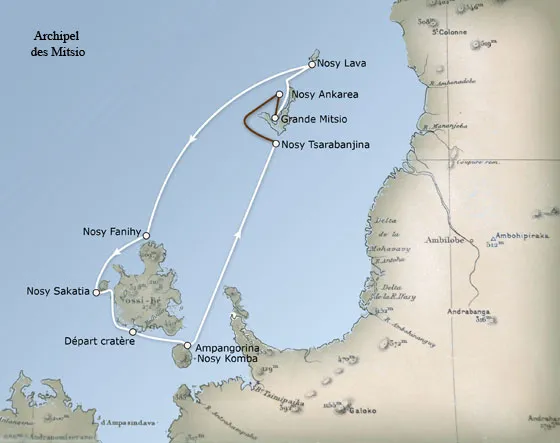
to the north-west, the Four Brothers gradually come into view. These four distinctive volcanic monoliths form a quadrilateral rising from the surface of the sea. From certain angles, they appear perfectly aligned.

According to legend, at the dawn of time, the gods sent five brothers to watch over the Mitsio Islands.

Following a family disagreement, one of them decided to leave. The brother closest to him began to waste away with grief, to the point that no birds now come to nest there. The brother who left settled off the coast of the Bay of Russians and is known as Sugarloaf, or the Diamond for those familiar with Martinique.

The sheer cliffs of these rocky domes make their summits inaccessible. They provide an ideal refuge for thousands of birds and a nesting site for hundreds of brown boobies, white-tailed tropicbirds and frigatebirds. Brown boobies (Sula leucogaster) often fly close to the Djebel Amour II before plunging into the ocean at breathtaking speed.

Frigatebirds (Fregata ariel and Fregata minor), with their slender silhouettes and black-and-white plumage, are known as “kleptoparasites”. They harass boobies in mid-flight to steal their food.

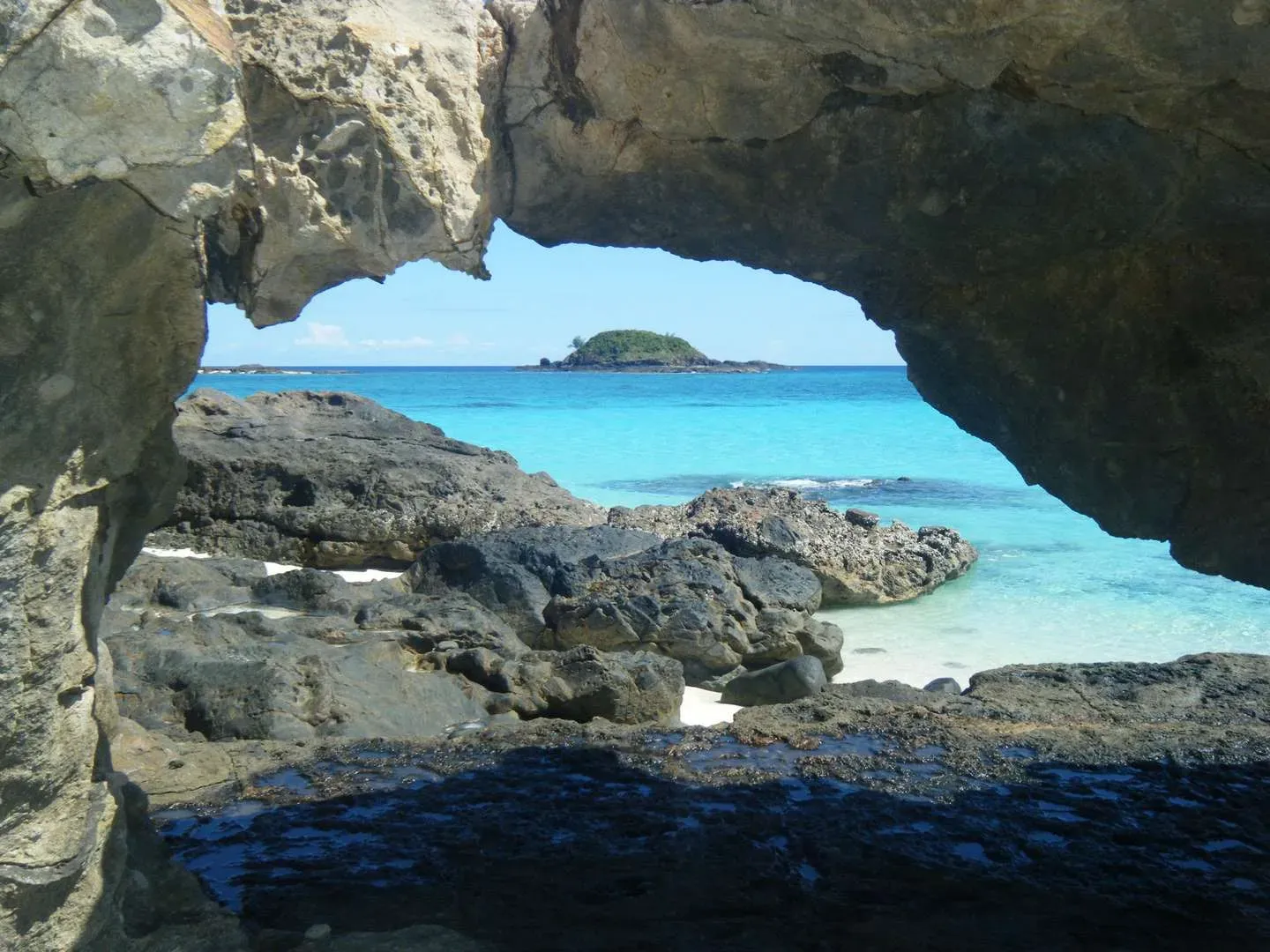
After the Four Brothers, we head towards Mitaraka Point, to the south-west of Grande Mitsio, where an extraordinary geological phenomenon is well worth the detour. Spectacular basalt columns plunge into the foaming waves. These long, hexagonal formations, several dozen metres high and arranged in perfectly vertical, symmetrical rows, look almost as though they had been carved by hand. The atmosphere here is magical.

“We soon arrive

at Nosy Ankarea, where lunch is served on board.

At 238 m, this is the highest point in the archipelago.

Located 5 nautical miles west of Grande Mitsio, this uninhabited island of basalt cliffs rises from the ocean with its flat summit resembling a mighty warship.

Despite its dark, imposing silhouette, the island is covered in lush vegetation.

Although it may appear challenging, the climb to the summit is accessible from the south-east side with a good pair of trainers. Madagascar flying foxes (Pteropus rufus), locally known as fanihy, soar above the cliffs with their distinctive calls. These fruit-eating bats are harmless.

The summit and steep cliffs are home to an exceptional forest of endemic vegetation, including pachypodiums, Hildegardia, euphorbias and baobabs.

The remarkably clear waters reveal coral reefs at depths of up to ten metres. Erosion has also created small, shallow natural pools with beautifully rounded shapes.

The conditions here are outstanding for underwater exploration.

Alternatively, a nap in a hammock beneath the tall mango trees lining the fine sandy beach is an equally tempting option for those who prefer relaxation to adventure.

“In the late afternoon,

we set sail at sunset and, over aperitifs, make our way to our sheltered anchorage in Maribe Bay, on the western side of Grande Mitsio.

Local fishermen may come alongside and offer to prepare a grilled goat barbecue on the beach for you (at an additional cost). Comfortably seated on mats around a campfire, this impromptu méchoui is a delicious experience. The festive and authentic atmosphere offers a wonderful opportunity to meet the island’s inhabitants, including Antakarana fishermen and Sakalava herders.

Grande Mitsio is the largest island in the archipelago, stretching for 12 km and fringed by numerous magnificent deserted beaches. Several trails allow you to explore the island and reach its high grassy hills, dotted with satrana palms, magnificent fan-shaped palm trees.

A few zebu cattle and goats are a reminder of the traditional pastoral life that still exists on the island.”

Day 3, 12 nautical miles away

Grande Mitsio
Nosy Lava

“Depending on

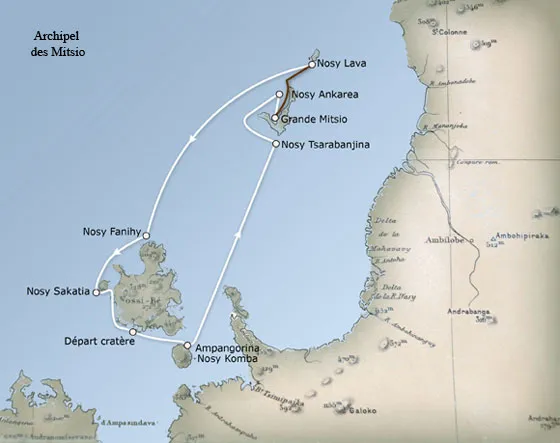
your excursions, we will set sail for Nosy Lava (approximately 2 hours). It is the second-largest island in the Mitsio archipelago, measuring 3.6 km in length. This uninhabited island has few beaches, but features a magnificent tombolo at its south-western tip. Depending on conditions, we will anchor nearby.

Nosy Lava (not to be confused with the island of the same name in the Radama archipelago) offers excellent snorkelling and popper fishing spots, thanks to its steep coastline, which is particularly attractive to predatory fish. The island’s interior is more difficult to explore due to its dense vegetation.*


Day 4, 50 nautical miles away

Nosy Lava
Nosy Fanihy
Nosy Sakatia

“Departure

for a long sail south-southwest towards Nosy Fanihy (a sacred island), at the northern tip of Nosy Be. As we pass the Four Brothers, you can stop for a snorkelling excursion if you wish. The waters surrounding this small island (1 km) are home to beautiful coral reefs and are highly recommended for snorkelling. A stunning stretch of sand is also perfect for sunbathing.

Just a short distance from Nosy Be, Nosy Sakatia welcomes you for your final night and a gentle return to civilisation. Located 1 nautical mile west of Nosy Be, it is known as the island of orchids and is home to a wide variety of tropical plants.

With a population of around 250 inhabitants, the island features beautiful forest trails winding through plantations of ylang-ylang, vanilla, pepper and coffee. Numerous chameleons and bats also make their home here.

This hilly island offers beautiful panoramic views from its higher ground. Around the villages, the scent of toka gasy, a traditional rum distilled in homemade stills, fills the air—an invitation to enjoy a tasting in moderation.

Depending on your preference, we can anchor either off a secluded beach or in front of one of the island’s two hotels.”

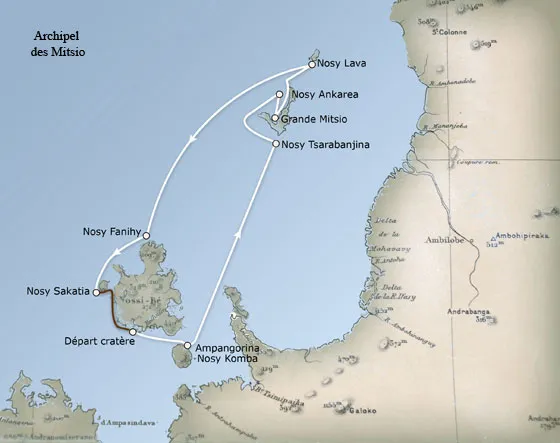
Day 5, 8 nautical miles away

Nosy Sakatia

“Depending on your departure time,

you can enjoy a leisurely visit to the island or return to Le Cratère in the morning.

This itinerary is provided as a guide only. You can shorten or extend your stay, or change certain destinations according to your wishes.

The choice of anchorages will depend on weather conditions.

We are at your disposal to help you create your tailor-made journey.”

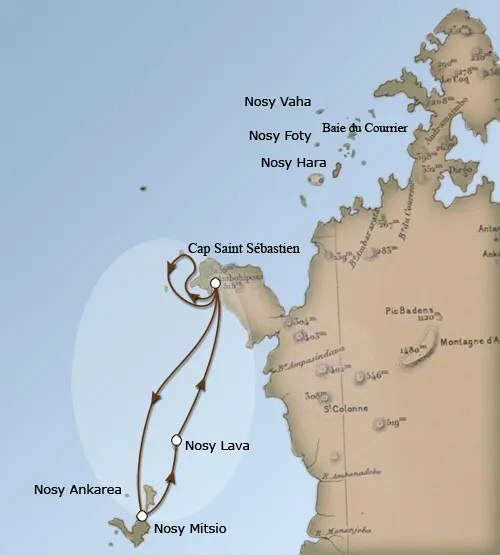
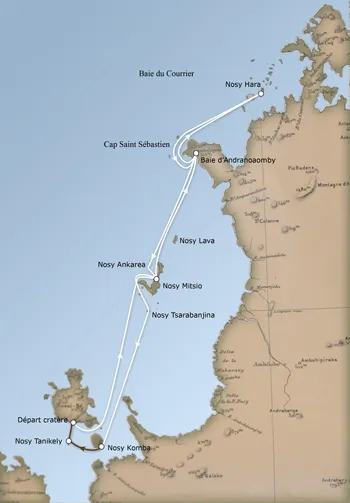
3-day extension

Cape Saint-Sébastien

“This extension,

combined with the “Wild North” cruise, takes you from the Mitsio Islands to Cape Saint-Sébastien and its many uninhabited islands. From Nosy Lava (starting on day 4), an 18-nautical-mile sail takes you to Andranoaomby Bay, sheltered from the Varatraza, the powerful north-easterly trade wind.

This small fishing village, made up of just a few dozen homes, offers a warm welcome.

The far end of the bay is bordered by an extensive mangrove forest. Passing Mandaovoa Point offers a magnificent view of the baobabs at the tip of the cape.

Two days are enough to explore the half-dozen islands surrounding the cape, with plenty of time to enjoy sunbathing, snorkelling and walks on land.”

Unspoilt archipelago

Courrier Bay:
“The citadels of the Varatraza”

“10 days

of adventurous cruising to discover the wildest and most unspoilt archipelago on Madagascar’s north-west coast.

Crossing the Mitsio Islands
The islands of Cape Saint-Sébastien
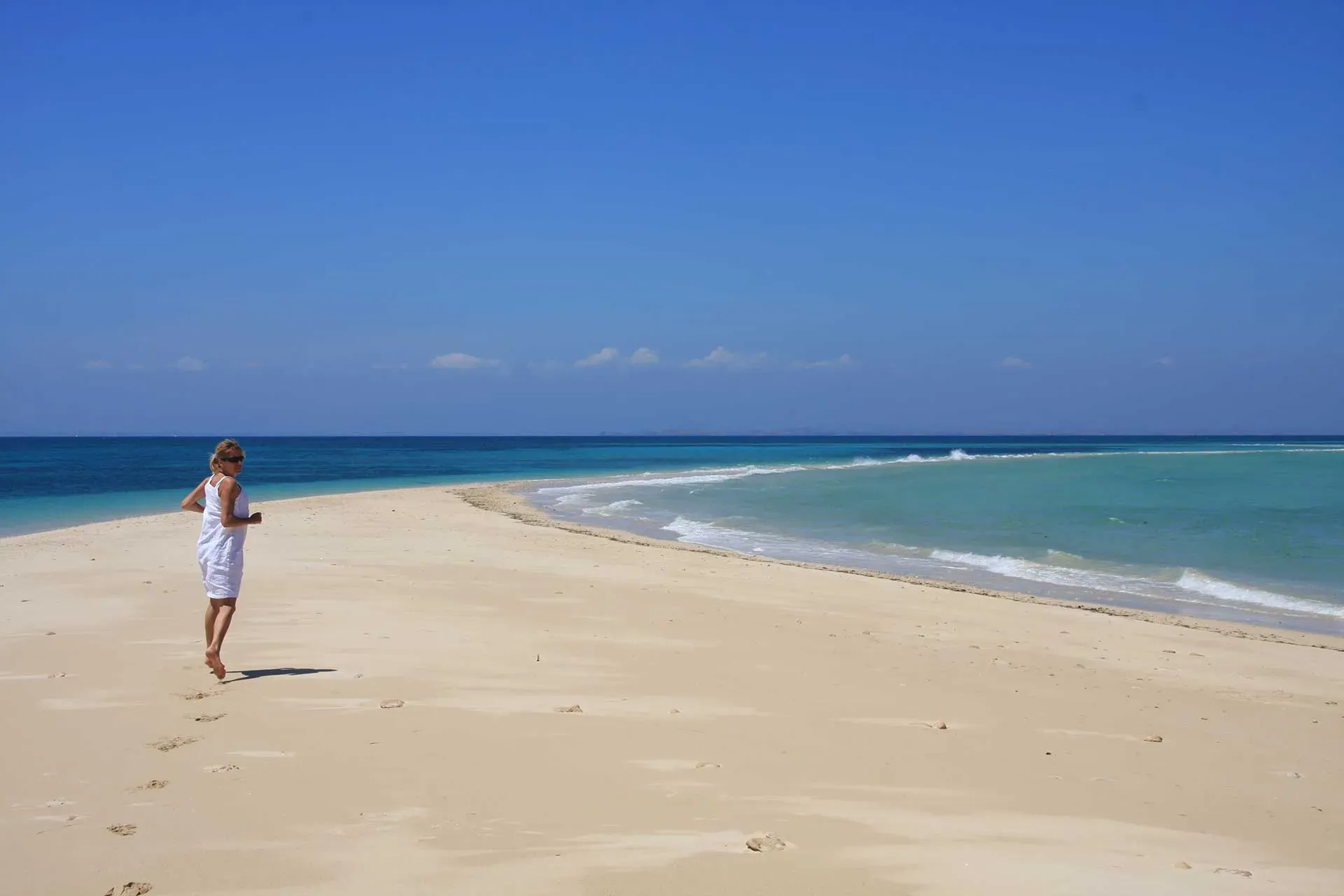
The Nosy Hara archipelago: the wildest islands on the north-west coast, with spectacular Tsingy formations plunging into the sea
Pristine, unspoilt coral reefs
Step by step

The itinerary

Days 1 & 2

Le cratère
Grande Mitsio
Baie d'Andranoaomby

“Early morning departure

from Le Cratère, the port of Nosy Be.

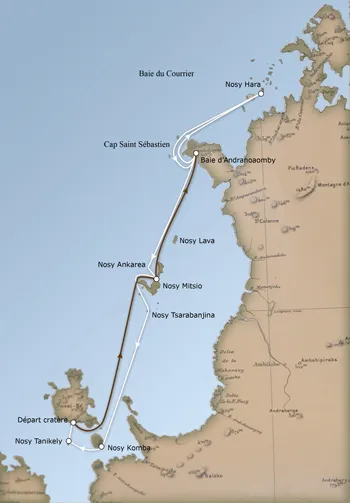
Sailing towards Courrier Bay is subject to the specific weather conditions of this area. The Varatraza, a powerful north-easterly trade wind, can blow fiercely and prevent access to the bay. The best periods for this cruise, when the Varatraza is calmer and there is no cyclone activity, are October to December, April and May. To maximise the chances of a successful crossing, two days of long-distance sailing are required to reach Cape Saint-Sébastien.

The decision to set sail for the Nosy Hara archipelago (28 nautical miles) is made from the anchorage at Andranoaomby, depending on a suitable weather window. When the Varatraza is established, it blows directly against the boat and creates rough, choppy seas, making the crossing difficult.

While waiting for the best conditions, the many islands around Cape Saint-Sébastien offer a magnificent area to explore. We remain ready to set sail as soon as conditions improve, by day or by night.

Given these conditions, the sailing itinerary remains subject to change. The crew will do everything possible to take you to your destination. Unfortunately, it may not always be possible to reach the archipelago. In this case, your cruise will take you through the islands of Cape Saint-Sébastien, the Orontany Peninsula, Ampamonty Bay and the Mitsio archipelago.

Day 1: early departure from Le Cratère to reach Grande Mitsio and the sheltered anchorage of Maribe (47 nautical miles).

Day 2: Grande Mitsio – Andranoaomby Bay (30 nautical miles).

A well-sheltered anchorage while waiting for the best conditions to reach Courrier Bay.”

Days 3, 4, 5 & 6

Discover
the archipelago

“A few days

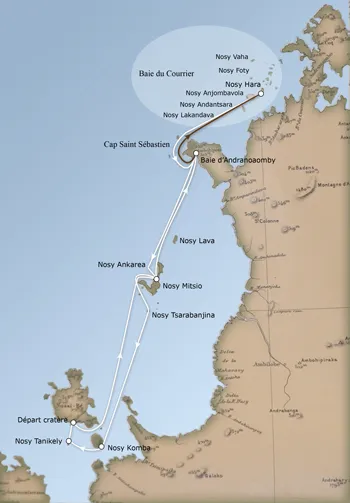
to explore the magnificent archipelago of this bay. From the sheltered anchorage at Nosy Hara, the islands are just a few nautical miles away and can be explored on day trips.

Nosy Hara

Long and narrow in shape, Nosy Hara measures 3.7 km by 600 m, covering an area of 312 hectares. The island is mainly composed of heavily eroded limestone, intersected by several wide fissures filled with dense vegetation ranging from 5 to 12 metres in height.

No significant caves are known to exist here, and the island does not appear to have a hydrographic network. Around ten beaches line its shores, including two particularly spectacular ones to the north and west, worthy of the most beautiful postcards. We usually anchor off the western beach.

The island is home to 31 species of birds and 16 species of reptiles, including the blue lizard, an endemic species of the Tsingy, and the Madagascar fish eagle, an endemic bird of prey internationally classified as endangered. Fanihy (Pteropus rufus, the large Madagascar flying fox) can also be found here.

To the north lies an immense coral reef stretching for around 15 km, with exceptionally rich marine flora and fauna. The protected area covers 55,550 hectares.

The island can be crossed on foot in around 2 hours along a 3 km trail. The walk begins from the beach, and the Djebel Amour will pick you up on the other side. The views are spectacular.

“From north to south

Nosy Vaha

A triangular coral islet measuring 600 m in length. With sparse vegetation, it features a beautiful beach at its south-western tip. Located close to the continental shelf drop-off, it is surrounded by a well-preserved coral reef.

Nosy Foty

With barely any vegetation, this sandy islet measures around 300 m in diameter and is entirely surrounded by beaches. Access is protected by a vast lagoon that becomes exposed at low tide. The reef drop-offs offer excellent snorkelling, and the island is also a good place for observing terns.

Nosy Antalalovo

Located 1.3 nautical miles from the Nosy Hara anchorage, this tiny 300 m islet features an eroded karst landscape and is surrounded by three small stretches of sand.

Nosy Anjombavola

The second-largest island in the archipelago, Nosy Anjombavola stretches for 1 km and is characterised by majestic limestone towers. A magnificent beach at its southern tip offers the perfect setting for snorkelling and relaxation.

The island is subject to several Fady (local taboos) due to the presence of royal tombs. Shouting, swearing, whistling, collecting shells and camping are prohibited. However, you may collect the many oysters attached to the submerged rocks.

Nosy Andantsara

The former NewSeaRoc camp no longer exists. The island was previously managed by NewSea Roc (Camp Corail). Mathieu Delacroix had obtained royal permission to climb on the island, subject to certain principles and rules designed to respect the spirits of the ancestors.

The island became a renowned climbing destination, with numerous climbing routes. It consists of two rocky peaks, one of which can be reached on foot and offers an extraordinary panoramic view over the entire bay.

Nosy Lakandava

Located just west of Nosy Andantsara, this island consists of several small islets connected by sandbanks. Even more dramatically sculpted than its neighbouring islands, its remarkable landscape resembles stone citadels rising from the sea.

The drop-offs along the west coast are easily accessible. At the northern end of the beach, a wooded area provides the perfect setting for a picnic and a nap in a hammock. Access at low tide can be difficult due to the exposed reef flat.

Nosy Mely

The southernmost islet in the archipelago is made up of basalt rocks. Its summit is easy to reach and offers a spectacular 360° panorama encompassing Courrier Bay, Amber Mountain and the islets of Nosy Hara.

The island features two beaches and numerous seashells, as well as a striking isolated rocky pinnacle at the end of one of the beaches.

Other small karst islets, including Nosy Ambatomarangitsi and Nosy Belomotro, are more difficult to access.”

Day 7

Archipelago
Cape Saint Sébastien

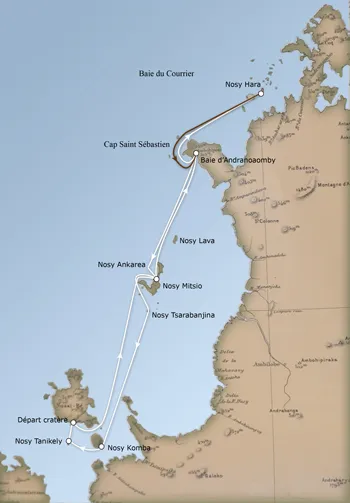
“A long downwind sail,

in favourable conditions, will take us to Cape Saint-Sébastien. We will anchor in the sheltered waters of Andranoaomby Bay.”

Day 8

Andranoaomby
Nosy Ankarea
Grande Mitsio

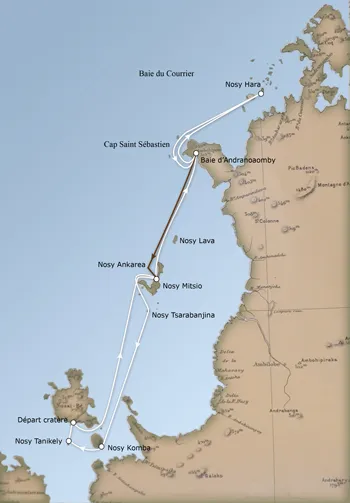
“Early morning departure

to reach Nosy Ankarea in time for lunch.

Ankarea is the highest island in the archipelago, with its summit rising to 238 m.

Located 5 nautical miles west of Grande Mitsio, this uninhabited island of basalt cliffs features a flat-topped summit rising from the ocean like a warship. Despite its dark and imposing silhouette, the island is covered in lush vegetation.

Although the climb may appear challenging, the summit can be reached from the south-east side with a good pair of trainers. Madagascar flying foxes (Pteropus rufus), locally known as fanihy, soar above the cliffs with their distinctive calls. These fruit-eating bats are harmless.

The summit and steep cliffs are home to an exceptional forest of endemic vegetation, including pachypodiums, Hildegardia, euphorbias and baobabs. The breathtaking views stretch from Cape Saint-Sébastien to Nosy Be, taking in the entire Mitsio archipelago.

The remarkably clear waters reveal coral reefs at depths of up to ten metres. Erosion has created small, shallow natural pools with beautifully rounded shapes, while the conditions are outstanding for underwater exploration.

Alternatively, a nap in a hammock beneath the tall mango trees lining the fine sandy beach is an equally tempting option for those who prefer relaxation to adventure.

In the late afternoon, we set sail at sunset and, over aperitifs, make our way to our sheltered anchorage in Maribe Bay, on the western side of Grande Mitsio.

“Anchorage at Grande Mitsio

At 12 km long, it is the largest island in the archipelago. Its coastline is fringed with numerous magnificent deserted beaches. Several trails allow you to explore the island and reach its high grassy hills, dotted with satrana palms, magnificent fan-shaped palm trees.

A few zebu cattle and goats are a reminder of the traditional pastoral life that still exists on the island.”

Day 9

Grande Mitsio
Tsarabanjina
Nosy Komba

“After leaving

Grande Mitsio, we head towards beautiful Nosy Tsarabanjina, also known as the island of white sand. A sacred land of the Sakalava people, it extends over around twenty hectares, with lush vegetation and pristine beaches. The island is home to abundant birdlife, including moorhens, frigatebirds, cormorants and, for the lucky ones, the Ankoay, or Madagascar fish eagle.

The island is home to a charming hotel whose bungalows blend discreetly into the unspoilt surroundings. After a swim in its turquoise waters, we continue towards Nosy Komba and its main village, Ampangorina.

“A peaceful village

with a warm, welcoming atmosphere, Ampangorina’s beachfront is lined with embroidered tablecloths made by local craftswomen. It is the perfect place to buy a few handicrafts or some vanilla.

Children and adults alike will enjoy visiting the lemur park, where the lemurs are remarkably friendly and particularly fond of bananas.

We will anchor for the night either in front of the village or to the south of the island, opposite the Tsara Komba Lodge. This quieter anchorage is the perfect opportunity to enjoy a sunset cocktail at this charming hotel. It also offers excellent dining, with reservations required 24 hours in advance.

A warm welcome always awaits us here, making it the perfect transition for a gentle return to civilisation.”

Day 10

Nosy Komba
Nosy Tanikely
Le cratère

“Morning departure

from Nosy Komba towards Nosy Tanikely National Park.

This tiny island is full of charm. An old lighthouse overlooks the island and offers 360° panoramic views. On the way up, you may encounter large colonies of fruit bats (Fanihy), as well as chameleons and lemurs.

The beauty of its underwater world is renowned, as is the variety of marine life that can be encountered here.

This is an unmissable destination, and the perfect final stop for snorkelling and swimming.

We will return to Le Cratère in the late afternoon.”

Escape

The Radama Islands:
“Gateway to the South”

“8 days

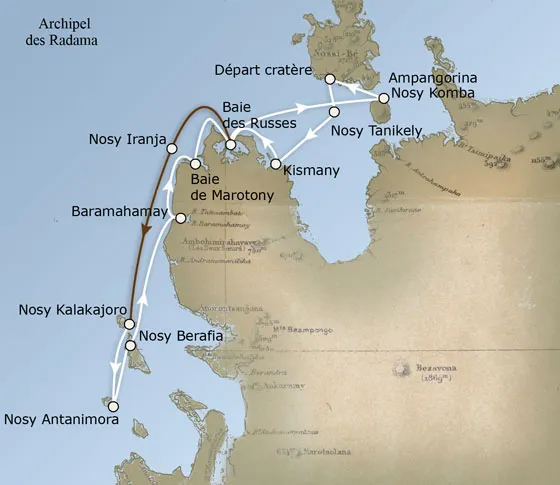
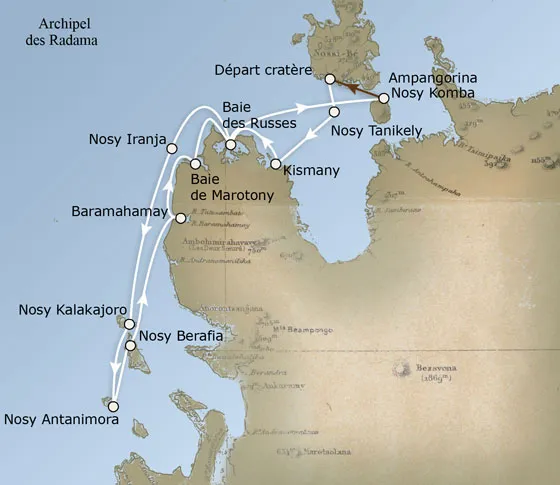
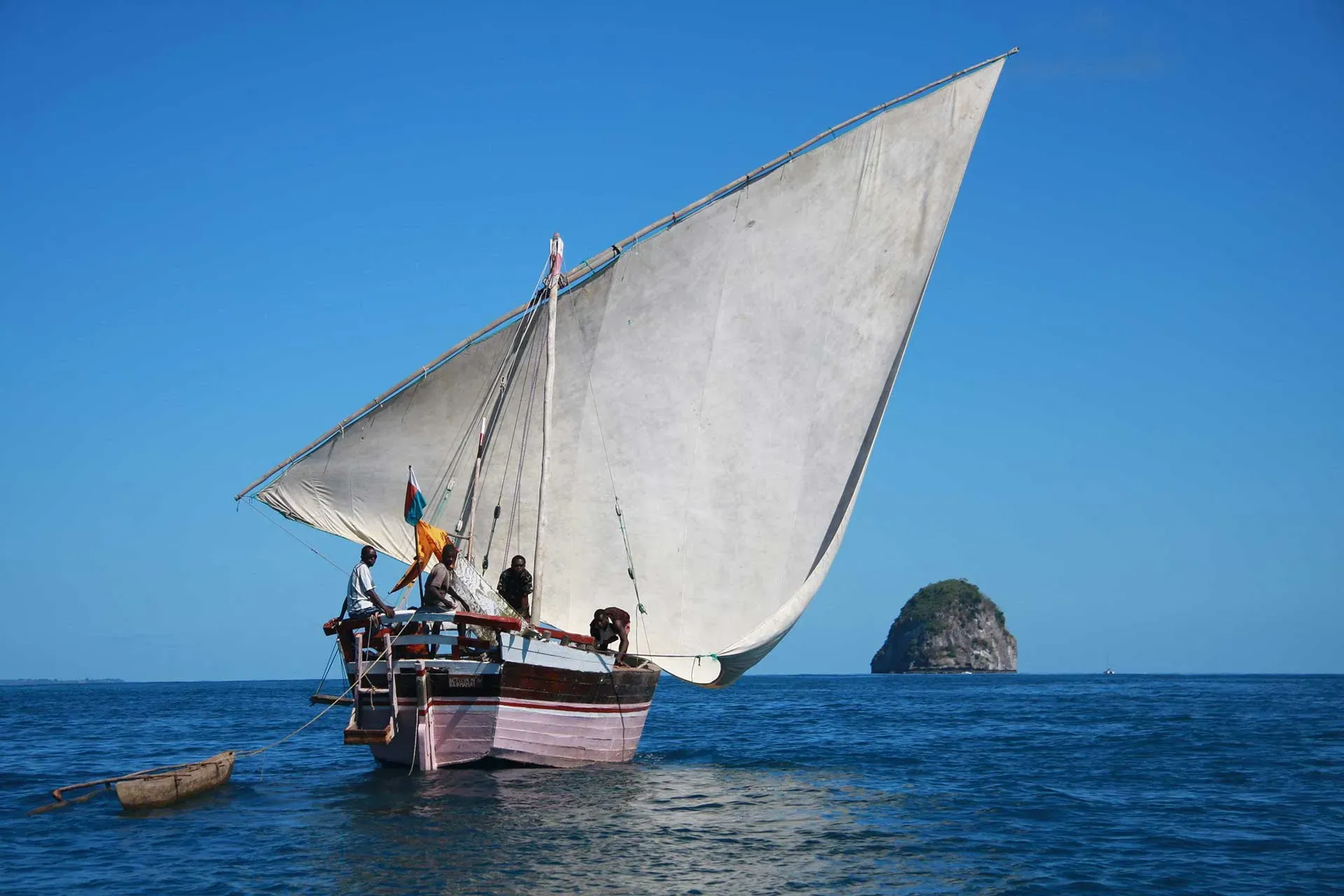
of escape in the Radama Islands, with kilometres of pristine beaches, welcoming fishing villages and hikes accessible to everyone. A stop at one of the most beautiful islands off the coast of Madagascar: the magical Nosy Iranja!

The historic site of the Bay of Russians
Crossing the Nosy Iranja tombolo
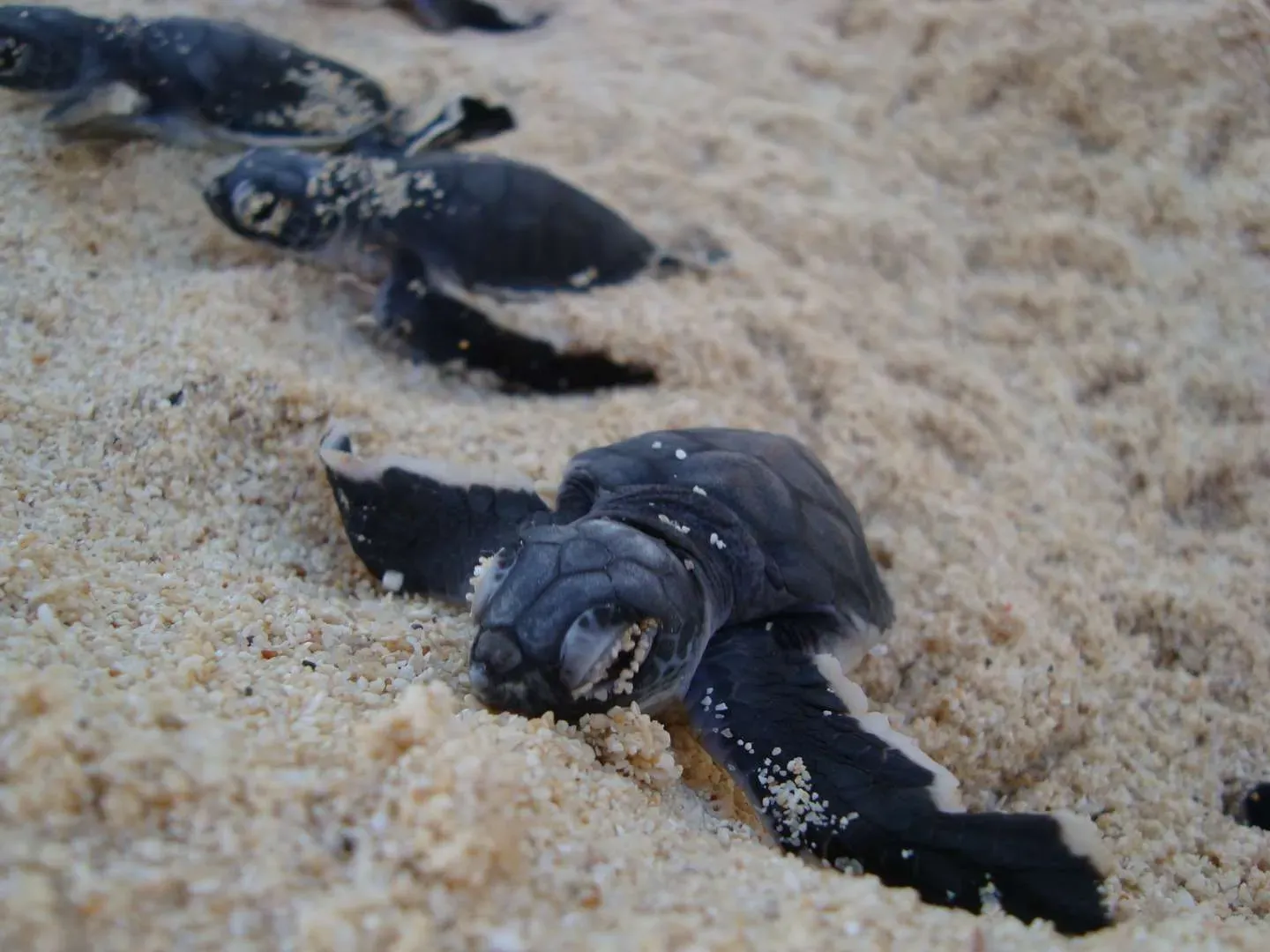
Sea turtle hatchings
Numerous whales during the breeding season
Baramahamay and its mangrove forest
A big-game fishing trip or an unforgettable dive at Kalakajoro

“Exclusive!

A caving adventure to discover the Bibi Ratsy cave.”
Step by step

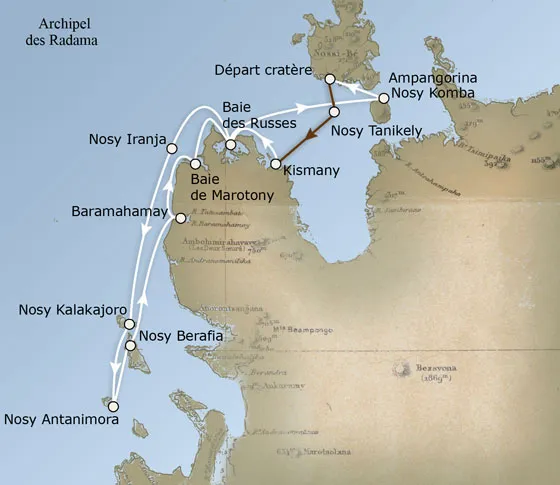
The itinerary

Day 1 - 17 miles

Nosy be
Tanikely
Kismany

“Departure

from Nosy Be towards Nosy Tanikely National Park. This tiny island is full of charm. An old lighthouse overlooks the island and offers 360° panoramic views. On the way up, you may encounter large colonies of fruit bats (Fanihy) and chameleons.

The beauty of its underwater world is renowned, as is the variety of marine life that can be encountered here. This is an unmissable destination and the perfect way to begin your journey, with snorkelling, swimming and lunch.

“Departure

in the early afternoon for the Kismany estuary, where we will enjoy a peaceful anchorage. A short walk can be taken to explore the small volcanic islet.

You can also head out by canoe or tender to travel up the river through the mangrove forest, home to numerous species of birds.

A visit to the village of Kismany offers a glimpse of local life. Every year, dhows from Zanzibar come here to stock up on shark oil.”

Day 2 - 8,5 miles

Kismany
Bay of Russians

“Several options:

Enjoy the boat and stop in the late morning at the magnificent Ampohana beach, with lunch either at anchor or on the beach.

Hike from Ampasimena to the Bay of Russians with our bilingual guide, Gervais, who is the district president and has extensive knowledge of the local wildlife and vegetation. This remarkably varied walk offers magnificent views over the Bay of Nosy Be and its islets, followed by sweeping views over the Bay of Russians. A picnic lunch is provided.

The hike ends on the Marolay Peninsula, on the eastern side of the bay, where the boat will be waiting for you. These two options can easily be combined, with some guests remaining on board while others enjoy the hike.

Walking time: approximately 4 hours.
Distance: approximately 10.3 km.
Total elevation gain: 320 m.

⇀ View the hike

A shorter walk is also available from the village of Ampohana to the ridges overlooking the Bay of Russians.

Walking time: 3 hours 45 minutes.
Distance: 9.7 km.
Total elevation gain: 300 m.

⇀ View the hike

“Anchorage and overnight stay

sheltered by the Ankatafa Peninsula, at the entrance to the magnificent Bay of Russians, an inland sea measuring approximately 8.5 by 6.5 km.

The marine environment is remarkable for its beauty and biodiversity. The area is known for dolphins, whale sharks and manta rays. Humpback whales migrate here from Antarctica to mate and give birth.

Dinner can be enjoyed on board or as a barbecue on the beach.

“A little history,

the Bay of Russians takes its name from an Imperial Russian squadron that sailed from St Petersburg and stopped here from December 1904 to March 1905.

On 16 March 1905, the Russian squadron set sail for Japan, where it was later decimated by the Japanese at the Battle of Tsushima.”

Day 3 - 35 milles

Bay of Russians
Nosy Iranja
Nosy Kalakajoro

“Leaving

the Bay of Russians, you can stop at Sugarloaf, an isolated volcanic islet with steep cliffs, where you can enjoy some excellent snorkelling.

A two-hour sail south takes you to Nosy Iranja, the island of turtles. Ranked among the 30 most beautiful islands in the world, it consists of two idyllic islets, Nosy Iranja Be (200 ha) and Nosy Iranja Kely (13 ha), connected by a long white-sand bank that emerges at low tide. The coral reefs and crystal-clear waters are simply breathtaking.

From the top of the lighthouse built by Gustave Eiffel, at the summit of Iranja Be, the larger island, you can enjoy spectacular 360° views. Once powered by paraffin, the lighthouse no longer shines, but its tall metal structure still dominates the landscape. In the shade of majestic, centuries-old mango trees, the former lighthouse keeper’s house has been converted into a primary school.

“Swimming is highly

recommended while waiting for Chef Lugon to prepare one of his specialities.

Iranja Kely is home to a charming hotel, Nosy Iranja Lodge. It is the perfect place to enjoy an aperitif or lunch while taking in the idyllic surroundings (reservation required).

You can also visit the sea turtle nesting site on Iranja Kely with a WWF guide.

After lunch, we continue towards the Radama archipelago, with the trolling lines in the water in the hope of catching something for dinner.

Depending on sea conditions, we will anchor in the shelter of one of the four northern islands of the archipelago.

Day 4

Discover
The Radama archipelago

“From north to south:

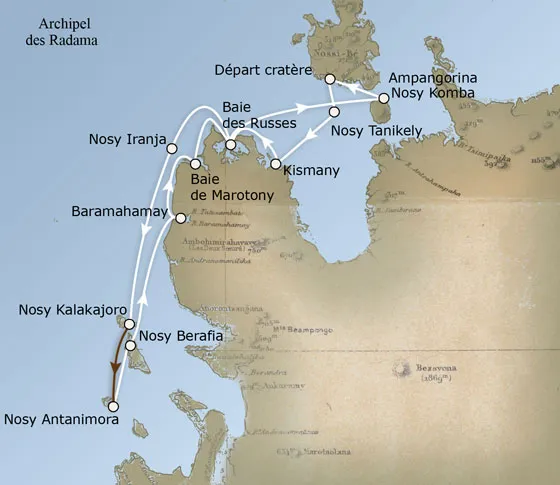
Nosy Kalakajoro, Nosy Berafia, Nosy Antanimora.

Nosy Kalakajoro

The highest island in the Radama archipelago.

A walk to the top of the island offers magnificent panoramic views. The island’s lush vegetation has long attracted skilled traditional boatbuilders, known locally as “foundi”. From generation to generation, they have preserved their traditional expertise and techniques, working exclusively with an adze to build elegant dhows that are a source of great pride to their owners, including traders from Analalava, Nosy Be and remote trading posts along this wild coastline.

Nosy Berafia

The largest of the four northern islands, measuring 10 km long and 3 km wide.

In the south of the island, you will find plantations of coffee, ylang-ylang, pepper and chillies. A visit to the village of Mahabo requires respect for certain local customs, as the village is home to Sakalava royal tombs and the Kabary house, where traditional rites and community discussions continue to be held.

A visit to the colonial house of the former concession’s “commander” will transport you back to the exotic, old-world atmosphere of the 1920s. You may also have the opportunity to visit a traditional distillery. The island is home to numerous bats and green pigeons, and you can also purchase fresh fruit and vegetables.

Nosy Antanimora

A small, isolated island whose name means “the easy land”.

A short hike to the top of the island reveals a spectacular panorama. Hundreds of birds have made the island their nesting ground.

At the south-eastern tip, a magnificent sandbank emerges at low tide. The long beach on the north-eastern coast is home to a large Vezo fishing camp.

The waters surrounding the island offer outstanding diving and spearfishing. The Radama archipelago also provides opportunities for big-game fishing trips and scuba diving excursions departing from Kalakajoro Island.

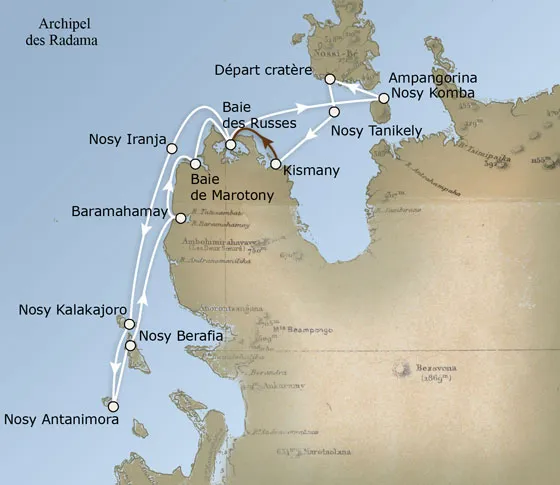
Day 5 - 20 miles

Radama
Baramahamay

“An early morning departure

will allow you to arrive around midday in Baramahamay, a charming village at the entrance to a river estuary on the mainland. The village is known for mangrove crab fishing — the crabs are enormous and delicious — and for harvesting wild honey.

Josiane and Théophile, the district president, along with the local schoolchildren, will give you a warm welcome.

You can spend the afternoon exploring the village and enjoying short walks in the surrounding area. A ridge trail starting above the village leads, in around an hour, to a magnificent beach and coconut grove.

For dinner, you can choose between eating on board or dining at “Aux bons crabes”, a small waterfront restaurant where you can enjoy an excellent homemade coconut punch.

Day 6 - 20 miles

Baramahamay
Marotony Bay
Bay of Russians

“For hikers,

a magnificent walk of around 12 km begins with a short trip by pirogue, followed by a hike to Marotony Bay, where the Djebel Amour will be waiting for you.

Those who prefer to relax on board can enjoy a lie-in, a swim and a leisurely morning before setting sail to meet the hikers in Marotony Bay in the early afternoon.

Depending on the timing, lunch will be served either at anchor or on the way to the Bay of Russians, approximately 3 hours of sailing.

Dinner can be enjoyed on board or on the beach, surrounded by the spectacular scenery of the Bay of Russians.


Day 7 - 22 miles

Bay of Russians
Ampangorina:
Nosy Komba Island

“Arriving

in Ampangorina in the late morning offers a gentle return to civilisation. This peaceful, welcoming village has a beachfront lined with embroidered tablecloths made by local craftswomen, making it the perfect place to buy a few local handicrafts.

A beautiful hike will take you to the summit of this volcanic island (622 m), while other trails lead to various parts of the island.

Children and adults alike will enjoy visiting the lemur park, where the lemurs are remarkably friendly and particularly fond of bananas.

For dinner, depending on your preference, you can dine either on board or at one of the many small waterfront restaurants.

Day 8

Return to our home port
« le cratère »

“Plan your day as you wish:

Return directly to Le Cratère (1 hour 30 minutes of sailing),

or sail around Nosy Komba, discovering its beautiful, unspoilt southern beaches (4 to 5 hours).

Hikers can cross the island from north to south and be picked up at one of the beaches or villages on the southern coast (3 to 4 hours of walking, depending on the route).

Alternatively, visit the Lokobé Nature Reserve, in the south of Nosy Be. Enjoy a 1 to 2-hour walk through dense vegetation, home to numerous lemurs, harmless boa constrictors, as well as many birds, chameleons and lizards. Allow around 2 hours for the walk and 3 hours of sailing to return to Le Cratère.

This itinerary is provided as a guide only. You can shorten or extend your stay, or change certain destinations according to your wishes. The choice of anchorages will depend on weather conditions.

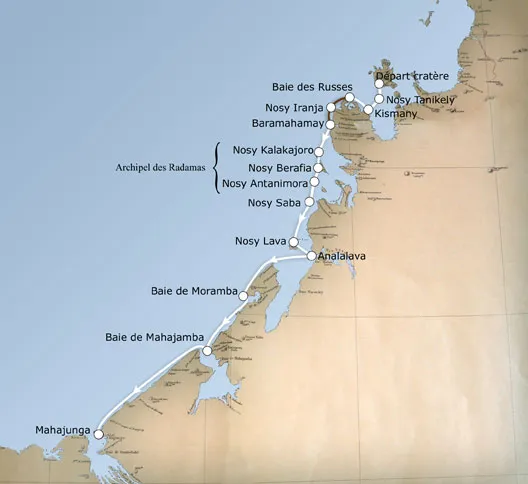
We are at your disposal to help you create your tailor-made journey.”

Heading south

One way Mahajunga

“10 days

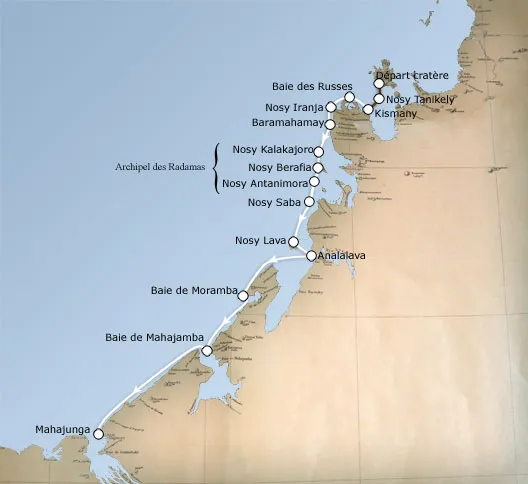
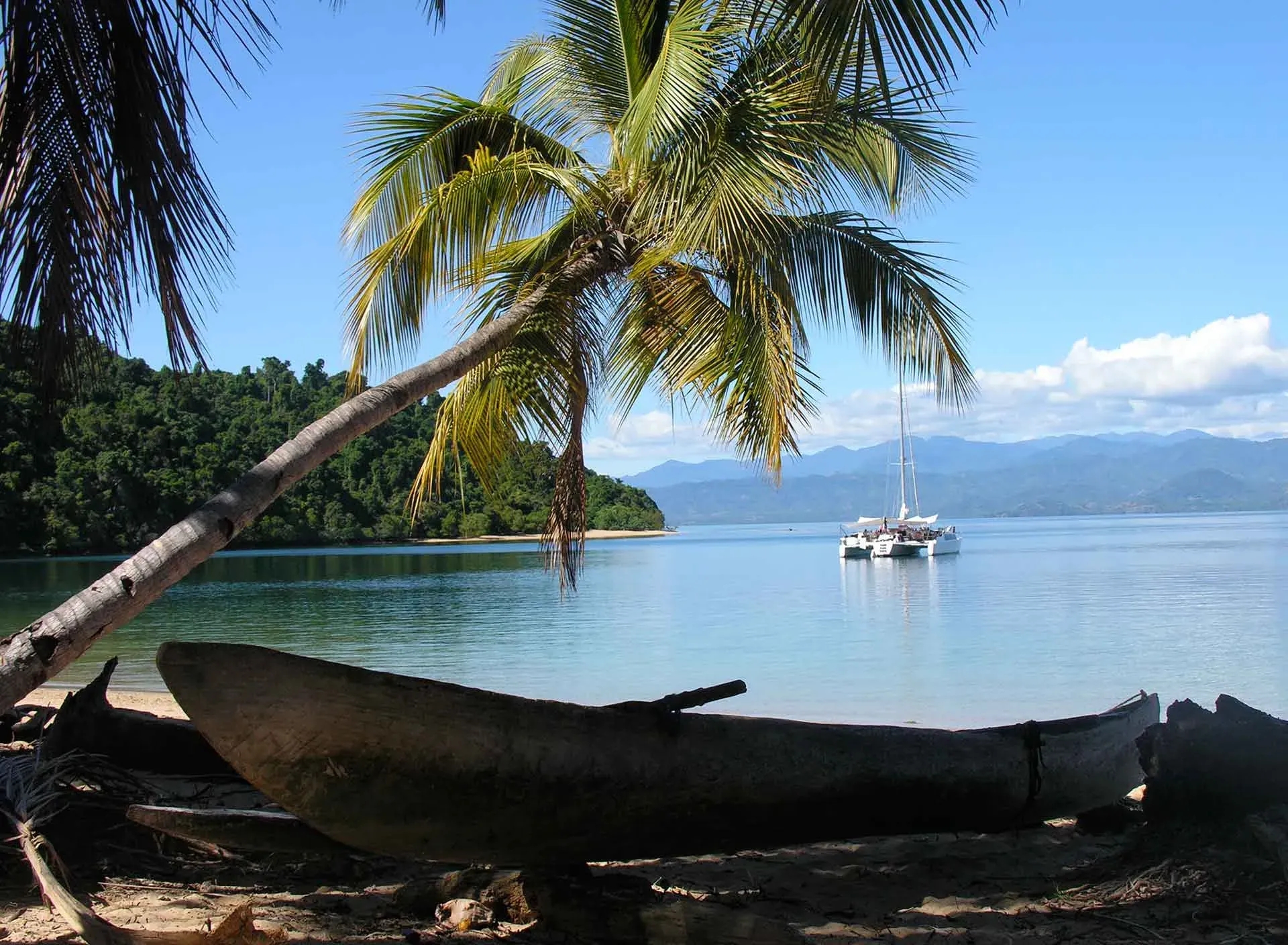
heading due south through the land of the Vezo people. A true adventure in complete safety, offering the opportunity to discover some of the wildest anchorages along Madagascar’s west coast.

Explore the entire Radama archipelago
Nosy Saba and its crystal-clear waters
The historic site of Nosy Lava and its former penal colony
The old-world charm of Analalava
Moramba Bay, a miniature Halong Bay
Step by step

The itinerary

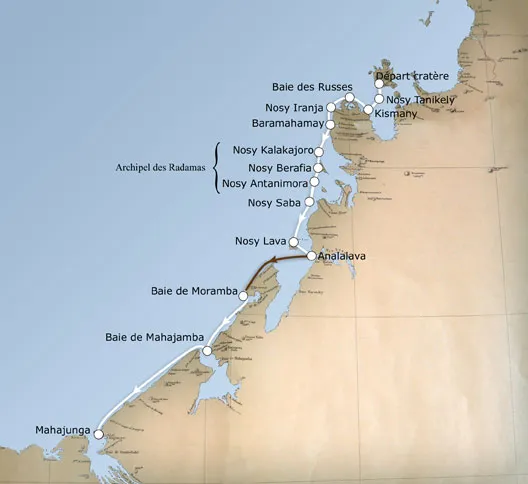
Day 1 - 17 miles

Nosy be
Tanikely
Kismany

“Departure from

Nosy Be towards Nosy Tanikely National Park. This tiny island is full of charm. An old lighthouse overlooks the island and offers 360° panoramic views. On the way up, you may encounter large colonies of fruit bats (Fanihy) and chameleons.
The beauty of its underwater world is renowned, as is the variety of marine life that can be encountered here. This is an unmissable destination and the perfect way to begin your journey, with snorkelling, swimming and lunch.

“Departure

in the early afternoon for the Kismany estuary, where we will enjoy a peaceful anchorage. A short walk can be taken to explore the small volcanic islet.

You can also head out by canoe or tender to travel up the river through the mangrove forest, home to numerous species of birds.

A visit to the village of Kismany offers a glimpse of local life. Every year, dhows from Zanzibar come here to stock up on shark oil.

Dinner on board.

Day 2 - 8,5 miles

Kismany
Bay of Russians

“Several options:

Enjoy the boat and stop in the late morning at the magnificent Ampohana beach, with lunch either at anchor or on the beach.

Hike from Ampasimena to the Bay of Russians with our bilingual guide, Gervais, who is the district president and has extensive knowledge of the local wildlife and vegetation. This remarkably varied walk offers magnificent views over the Bay of Nosy Be and its islets, followed by sweeping views over the Bay of Russians. A picnic lunch is provided.
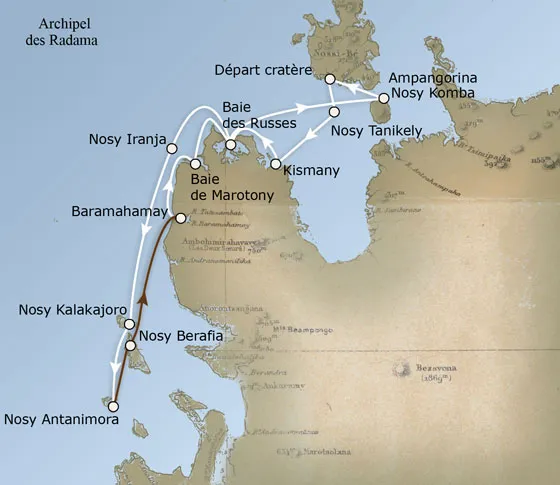
The hike ends on the Marolay Peninsula, on the eastern side of the bay, where the boat will be waiting for you.

Walking time: approximately 4 hours.
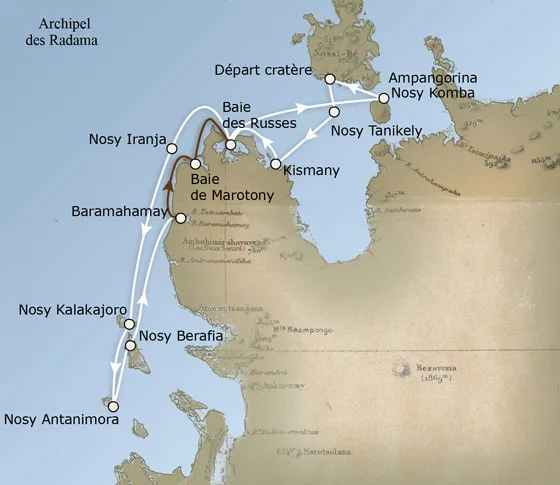
Distance: approximately 10.3 km.
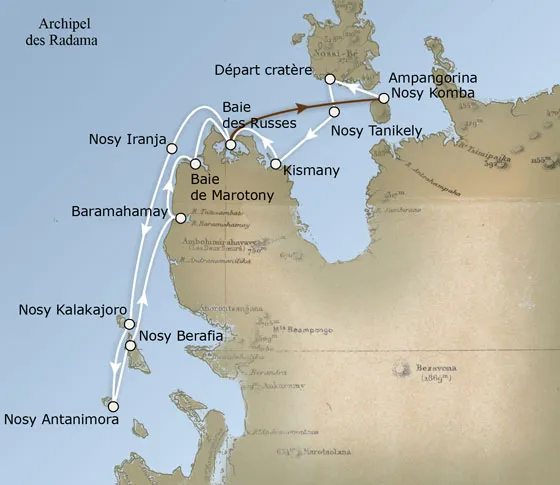
Total elevation gain: 320 m.

⇀ View the hike

We can also offer a shorter walk from the village of Ampohana to the ridges overlooking the Bay of Russians.

We will anchor for the night in the shelter of the Ankatafa Peninsula, at the entrance to the magnificent Bay of Russians, an inland sea measuring approximately 8.5 by 6.5 km.

The marine environment is remarkable for its beauty and biodiversity. The area is known for dolphins, whale sharks and manta rays. Humpback whales migrate here from Antarctica to mate and give birth.

Dinner can be enjoyed on board or as a barbecue on the beach.

Walking time: 3 hours 45 minutes.
Distance: 9.7 km.
Total elevation gain: 300 m.

⇀ View the hike

These different options can easily be combined, with some guests choosing to remain on board while others enjoy the hikes.

“A little history,

the Bay of Russians takes its name from an Imperial Russian squadron that sailed from St Petersburg and stopped here from December 1904 to March 1905.

On 16 March 1905, the Russian squadron set sail for Japan, where it was later decimated by the Japanese at the Battle of Tsushima.”

.

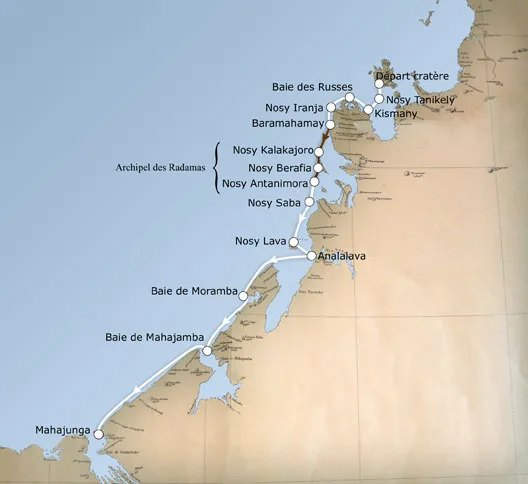
Day 3 - 35 miles

Bay of Russians
Nosy Iranja
Baramahamay

“Leaving

the Bay of Russians, you can stop at Sugarloaf, an isolated volcanic islet with steep cliffs, where you can enjoy some excellent snorkelling.

A two-hour sail south takes you to Nosy Iranja, the island of turtles. Ranked among the 30 most beautiful islands in the world, it consists of two idyllic islets, Nosy Iranja Be (200 ha) and Nosy Iranja Kely (13 ha), connected by a long white-sand bank that emerges at low tide. The coral reefs and crystal-clear waters are simply breathtaking.

From the top of the lighthouse built by Gustave Eiffel, at the summit of Iranja Be, the larger island, you can enjoy spectacular 360° views. Once powered by paraffin, the lighthouse no longer shines, but its tall metal structure still dominates the landscape. In the shade of majestic, centuries-old mango trees, the former lighthouse keeper’s house has been converted into a primary school.

Swimming is highly recommended while waiting for Chef Lugon to prepare one of his specialities. Iranja Kely is home to a charming hotel, Nosy Iranja Lodge, the perfect place to enjoy an aperitif or lunch while taking in the idyllic surroundings (reservation required).

You can also visit the sea turtle nesting site on Iranja Kely with a WWF guide.

“An afternoon departure

will take you to Baramahamay in around one hour, a charming village at the entrance to a river estuary on the mainland. The village is known for mangrove crab fishing — the crabs are enormous and delicious — and for harvesting wild honey.

Josiane and Théophile, the district president, along with the local schoolchildren, will give you a warm welcome.

You can spend the rest of the afternoon exploring the village and enjoying short walks in the surrounding area. A ridge trail starting above the village leads, in around an hour, to a magnificent beach and coconut grove.

For dinner, you can choose between eating on board or dining at “Aux bons crabes”, a small waterfront restaurant where you can enjoy an excellent homemade coconut punch.


Days 4 & 5

Discover
The Radama archipelago

“From north to south:

Nosy Kalakajoro, Nosy Berafia, Nosy Antanimora.

Nosy Kalakajoro

The highest island in the Radama archipelago. A walk to the top of the island offers magnificent panoramic views.

The island’s lush vegetation has long attracted skilled traditional boatbuilders, known locally as “foundi”. From generation to generation, they have preserved their traditional expertise and techniques, working exclusively with an adze to build elegant dhows that are a source of great pride to their owners, including traders from Analalava, Nosy Be and remote trading posts along this wild coastline.

Nosy Berafia

The largest of the four northern islands, measuring 10 km long and 3 km wide.

In the south of the island, you will find plantations of coffee, ylang-ylang, pepper and chillies. A visit to the village of Mahabo requires respect for certain local customs, as the village is home to Sakalava royal tombs and the Kabary house, where traditional rites and community discussions continue to be held.

A visit to the colonial house of the former concession’s “commander” will transport you back to the exotic, old-world atmosphere of the 1920s. You may also have the opportunity to visit a traditional distillery. The island is home to numerous bats and green pigeons, and you can also purchase fresh fruit and vegetables.

Nosy Antanimora

A small, isolated island whose name means “the easy land”.

A short hike to the top of the island reveals a spectacular panorama. Hundreds of birds have made the island their nesting ground.

At the south-eastern tip, a magnificent sandbank emerges at low tide. The long beach on the north-eastern coast is home to a large Vezo fishing camp, where fishermen traditionally catch sharks and sea cucumbers.

The waters surrounding the island offer outstanding diving and spearfishing.


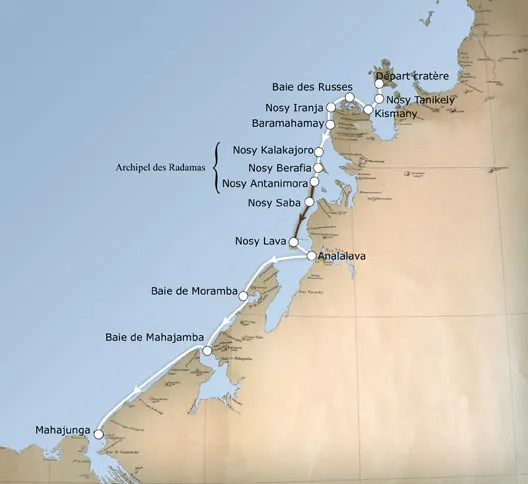
Day 6 - 25 miles

Radama
Nosy Saba
Nosy Lava

  • Nosy saba

Surrounded by turquoise waters, this 128-hectare private island features kilometres of fine sandy beaches and a coral reef teeming with exotic fish, creating a truly Polynesian atmosphere.

With the owners’ permission, you can enjoy a swim, visit the Nosy Saba Lodge, have lunch at its gourmet restaurant and relax by the lagoon-side swimming pool. Spa treatments and revitalising massages are also available.

Departure in the afternoon for Nosy Lava.

  • Nosy lava

This small island is sadly known for its penal colony, built by the French in 1911. The prison closed in 2000, but some former prisoners without the means to leave have remained on the island. Meeting these former convicts offers a unique and moving human experience.

You can explore the remains of the colonial prison, visit fishing villages and discover Sakalava tombs.

The island is also home to a spring known as the “French Spring”, where lush vegetation grows along the cliffside. Its old lighthouse is well worth a visit, offering sweeping views towards Nosy Saba to the north, Analalava to the east and Maromony Point to the south.

The surrounding waters offer numerous outstanding spearfishing sites.

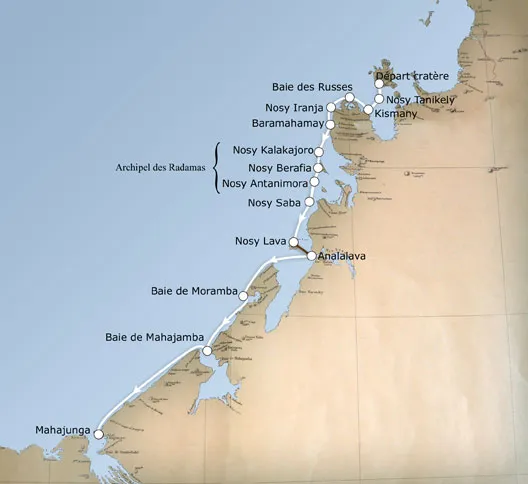
Day 7 - 10 miles

Nosy Lava
Analalava

“A charming

seaside resort dating back to the colonial era. This sheltered spot provides an excellent anchorage from which to discover a delightful little coastal town with sandy streets.

This secluded village seems to have drifted into a gentle melancholy. Many traces of its colonial past remain, including the Varatraza Hotel. The Malibu Hotel, with its beachfront bungalows, offers excellent cuisine and a disco on Saturday nights.

Just beyond the colonial town, a traditional Sakalava fishing village sits along the sandy shore. A local boatyard, renowned throughout the region, offers the opportunity to see dhows and traditional “lakana” canoes being built.

The market and local hotely (traditional Malagasy eateries) are ideal places to meet the town’s warm and welcoming inhabitants.

This stopover is also an opportunity to stock up on drinks and fresh provisions.”

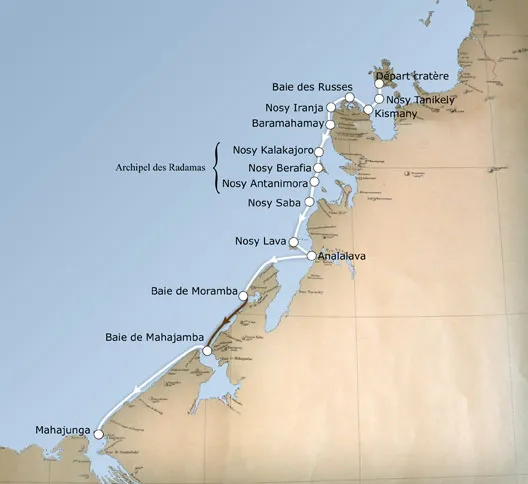
Day 8 - 37 miles

Analalava
Moramba Bay

“A small bay

with exceptionally calm waters, known as Madagascar’s “little Halong Bay”. This anchorage offers spectacular scenery, with numerous limestone islets rising from the sea and covered with different varieties of baobabs.

The area is home to many lemurs, including Verreaux’s sifakas, as well as the extremely rare Ankoay, or Madagascar fish eagle.

Numerous coves reveal small secluded beaches, perfect for a desert-island escape.

A trip around the bay will take you to a traditional village where fishing for shrimp and freshwater prawns is carried out exclusively by women.

Dinner can be enjoyed on board or on the beach, depending on your preference.”

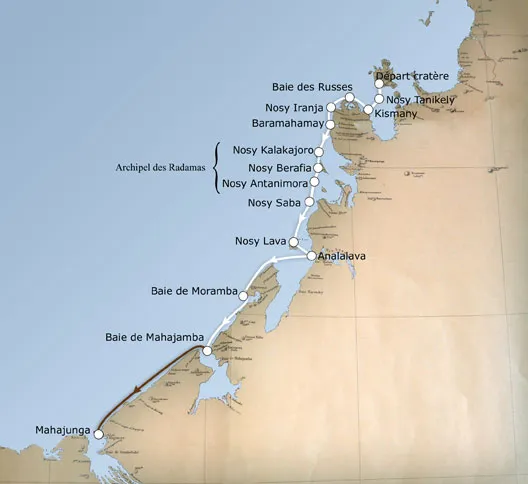
Day 9

Moramba Bay
Terres Blanches Lodge
or Mahajamba Bay

“Depending on the weather:

Stopover at Terres Blanches Lodge (20 nautical miles).

This charming lodge is surrounded by 7 km of deserted coastline, with romantic white-sand coves separated by Tsingy formations and stretches of water bordered by mangroves.

The owners will be delighted to help you discover this magnificent region, whether on foot, by bicycle, motorbike or kayak. Paramotoring is also available.

The many secluded coves are home to lemurs, green parakeets, fish eagles and paradise birds. If you would like to try big-game fishing, the surrounding waters are rich in pelagic fish.

A beautifully laid table on the beach, beneath a sky full of stars, awaits you for dinner.

Alternatively, we can anchor in Mahajamba Bay, with its many beaches and mangroves.”

Day 10 - 50 miles

Mahajamba Bay
Mahajunga

“A long sail

south-west, along endless stretches of white-sand beaches, takes us to Mahajanga.

The largest city on Madagascar’s west coast, its name is thought to derive either from the Malagasy “Maha Janga”, meaning “that which brings healing”, or from the Swahili “Mji angaïa”, meaning “city of flowers”.

Open to the Mozambique Channel, the city has long been a place of encounters, trade and cultural exchange.

As Madagascar’s second-largest port, Mahajanga is also one of the hottest cities on the island. Its pleasant climate, superb white-sand beaches, unspoilt natural surroundings and magnificent landscapes make it an ideal place to spend a few days.

Your choice of destination

A night on board

“2 days

for a short escape, with 4 destinations to choose from.

Bay of Russians
Nosy Iranja
Nosy Komba – Nosy Tanikely
Nosy Tsarabanjina

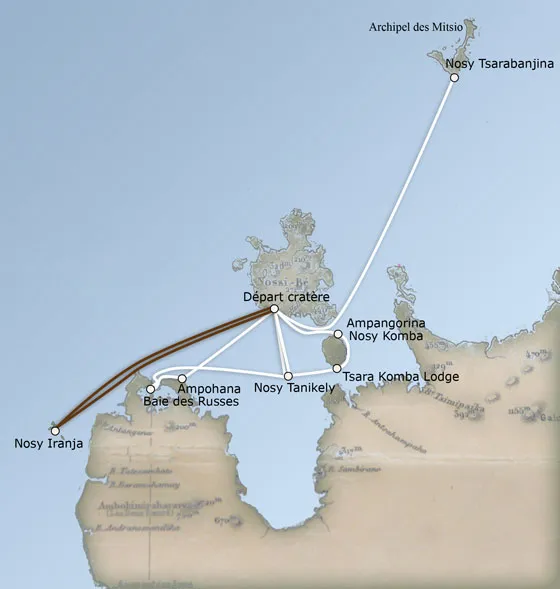
Your choice of itinerary

The programme

2 days & 1 night

A night on board

“You have

two days to sail the turquoise waters of Nosy Be, discovering secluded beaches along the mainland or on the surrounding islands.

You are looking for peace and tranquillity, a chance to switch off from work and leave everyday stress behind.

Your journey through Madagascar is coming to an end, and you would like to enjoy a gentle transition before returning to civilisation.

Or perhaps you simply want to relax aboard a comfortable and spacious yacht: unwind on the king-size bench seat, soak up the sun on the trampolines, and enjoy a gourmet candlelit dinner beneath the stars...

The Djebel Amour II and its crew are at your service to offer you a complete change of scenery and a truly relaxing escape.

To make the most of your two-day getaway, an early departure from Le Cratère, the port of Nosy Be, is recommended. Breakfast will be served on board upon your arrival.

We will return in the late afternoon on the following day. When booking, we will be happy to discuss your menu preferences with you, with a selection of suggestions available from Chef Lugon’s menu.”

Your choice of destination

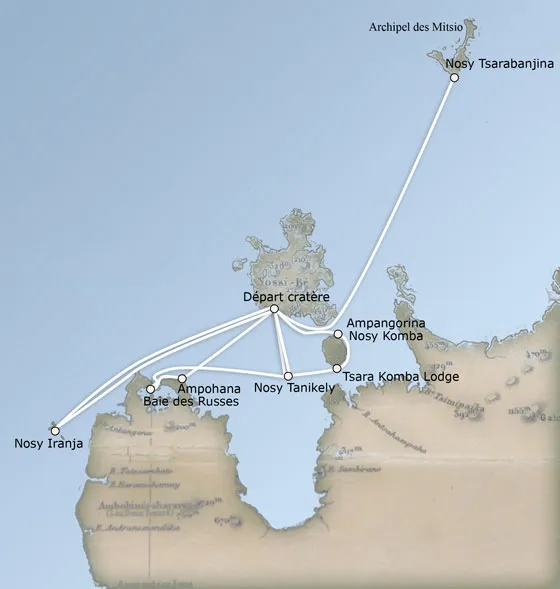
Bay of Russians

“Departure

from Le Cratère, the home port of the Djebel Amour II. Around midday, we arrive at Ampohana, a superb beach on the eastern side of the Bay of Russians, on the mainland.

Lunch on board, followed by swimming and snorkelling. In the afternoon, we set sail for the Bay of Russians, around 40 minutes away.

We will anchor for the night in the shelter of the Ankatafa Peninsula, at the entrance to the magnificent Bay of Russians, an inland sea measuring approximately 8.5 by 6 km.

Dinner can be enjoyed on board or on the beach.

In the morning, we set sail for Nosy Tanikely, which became Madagascar’s third national marine park in 2010. Enjoy snorkelling, swimming and lunch on the island.

This tiny island is full of charm. An old lighthouse overlooks the island and offers 360° panoramic views. The beauty of its underwater world is renowned, as is the variety of marine life that can be encountered here.

This is an unmissable destination that you are sure to enjoy.”

Your choice of destination

Nosy Komba
Nosy Tanikely

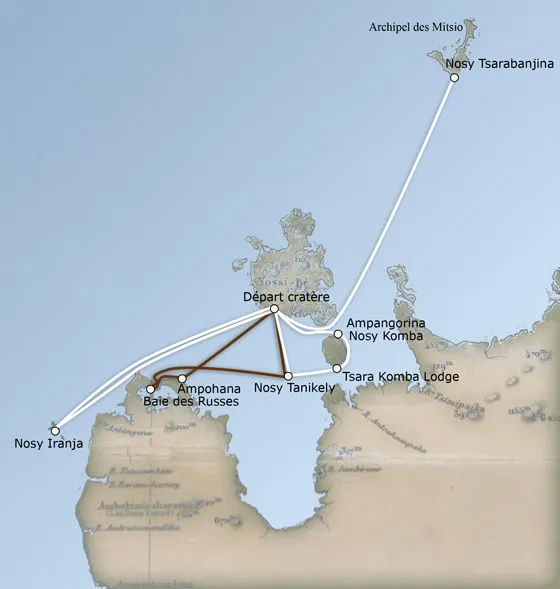
“Departure

from Le Cratère for Ampangorina (Nosy Komba). This peaceful, welcoming village has a beachfront lined with embroidered tablecloths made by local craftswomen, making it the perfect place to buy a few local handicrafts.

A beautiful hike will take you to the summit of this volcanic island (622 m), while other trails lead to various parts of the island. Children and adults alike will enjoy visiting the lemur park, where the lemurs are remarkably friendly and particularly fond of bananas. You will also have the opportunity to see tortoises.

Lunch is served on board as we sail along the east coast of Nosy Komba. We will anchor at the southern tip of the island, opposite the Tsara Komba Lodge, a luxury eco-lodge.

After breakfast, we head towards Nosy Tanikely National Park for snorkelling, swimming and lunch.

This tiny island is full of charm. An old lighthouse overlooks the island and offers 360° panoramic views. The beauty of its underwater world is renowned, as is the variety of marine life that can be encountered here. This is an unmissable destination that you are sure to enjoy!

In the afternoon, we return to the port of Le Cratère.”

Your choice of destination

Nosy Iranja

“This sailing route

around the Ampasindava Peninsula opens onto the Mozambique Channel and leads to one of Madagascar’s most beautiful islands: Nosy Iranja, the island of turtles.

Ranked among the 30 most beautiful islands in the world, it consists of two idyllic islets, Nosy Iranja Be (200 ha) and Nosy Iranja Kely (13 ha), connected by a long white-sand bank that emerges at low tide. The coral reefs and crystal-clear waters are simply breathtaking.

From the top of the lighthouse built by Gustave Eiffel, you can enjoy spectacular 360° views. At low tide, you can walk across the 1.2 km tombolo connecting the two islands.

You may even be lucky enough to witness baby sea turtles hatching. The island is home to a renowned 4-star hotel, where you can enjoy a drink with advance booking.

We set sail again late the following morning for the return journey to Le Cratère.”

Your choice of destination

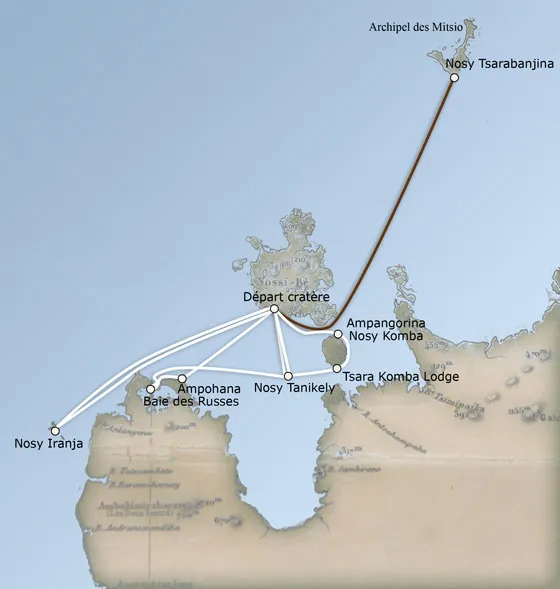
Tsarabanjina

“Reaching

this magnificent island, the northernmost of the Mitsio Islands, requires around 6 hours of sailing. Breakfast is served as we sail through the channel, with the Lokobé Reserve to port and Nosy Komba to starboard.

We then head north towards beautiful Tsarabanjina, also known as the island of white sand. A sacred land of the Sakalava people, it extends over around twenty hectares, with lush vegetation and pristine beaches.

The island is home to abundant birdlife, including moorhens, frigatebirds, cormorants and, for the lucky ones, the Ankoay, or Madagascar fish eagle.

The island is home to a charming hotel whose bungalows blend discreetly into its unspoilt surroundings.

We set sail again late the following morning, after enjoying swimming and snorkelling.”

Contact us

Need more information ?

Florence handles all aspects of the management and booking of your cruises. Feel free to contact her if you have any questions.